
Technology · Architecture
How FRP fits together.
Four core components, one protocol between robot and cloud, and a clean separation between the people who manage access and the robots that do the work.
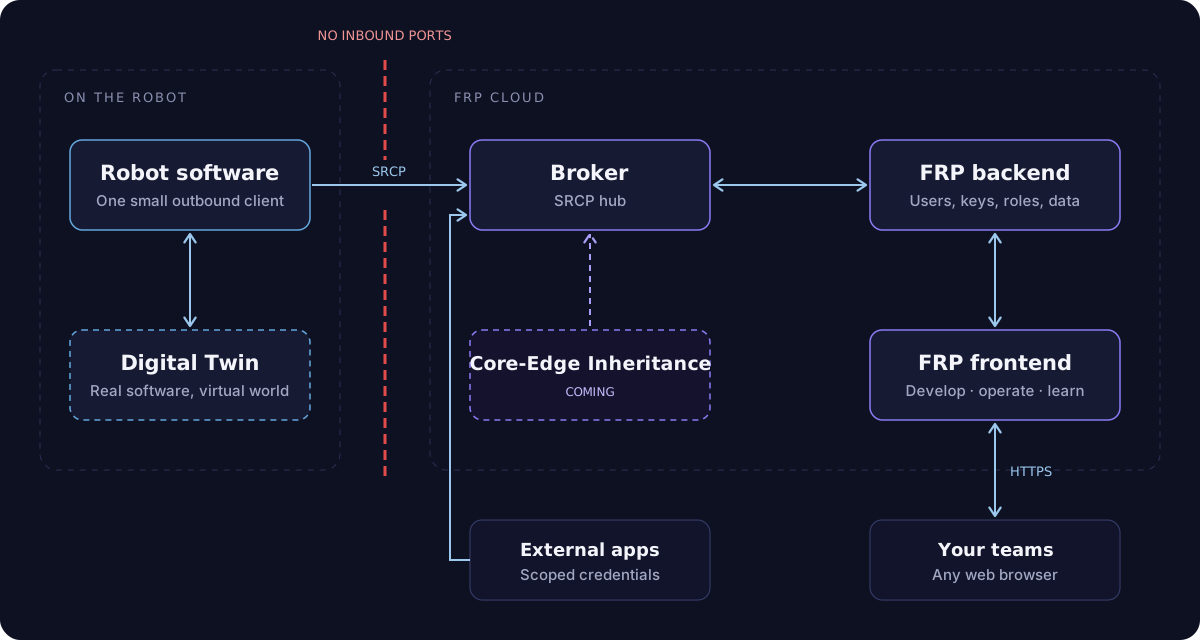
On the robot
Robot software
A compact C++ client on the robot’s computer (Raspberry Pi 5 or NVIDIA Jetson class). It connects outbound to the broker and runs the robot.
In the cloud
Broker
The SRCP hub. Robots, the platform and authorised external apps all connect to it; it routes telemetry, video, control and maintenance traffic.
In the cloud
FRP backend
Users, teams, keys, roles, projects and data. It decides who may talk to which robot.
In your browser
FRP frontend
The web application where teams develop, operate and train robots.
Alongside the robot
Digital Twin
In development. The robot’s own software connected to a virtual 3D world.
Coming
Core-Edge Inheritance
Our technology for managing AI across the fleet: a central AI that passes its knowledge to compact models on each robot.
Open to your software
Build your own applications on FRP.
External applications, such as a high-performance native control station, connect directly to the broker and talk to robots over SRCP. Access is managed centrally by the FRP backend and scoped to specific users and robot groups.
- Direct broker connection for performance
- Scoped credentials, never the master key
- Same protocol and security model as the platform itself
See FRP on your robots.
Tell us about your robots, your classroom or your mission. We will show you the platform end to end.